Dashain Festival in Nepal is the country's longest and most significant Hindu celebration, lasting 15 consecutive days and observed by more than 80% of Nepal's population. Rooted in the victory of Goddess Durga over the demon Mahishasura, Dashain represents the triumph of good over evil, and it transforms the entire nation, from mountain villages to Kathmandu's city streets, into a living, breathing celebration of family, devotion, and cultural identity.
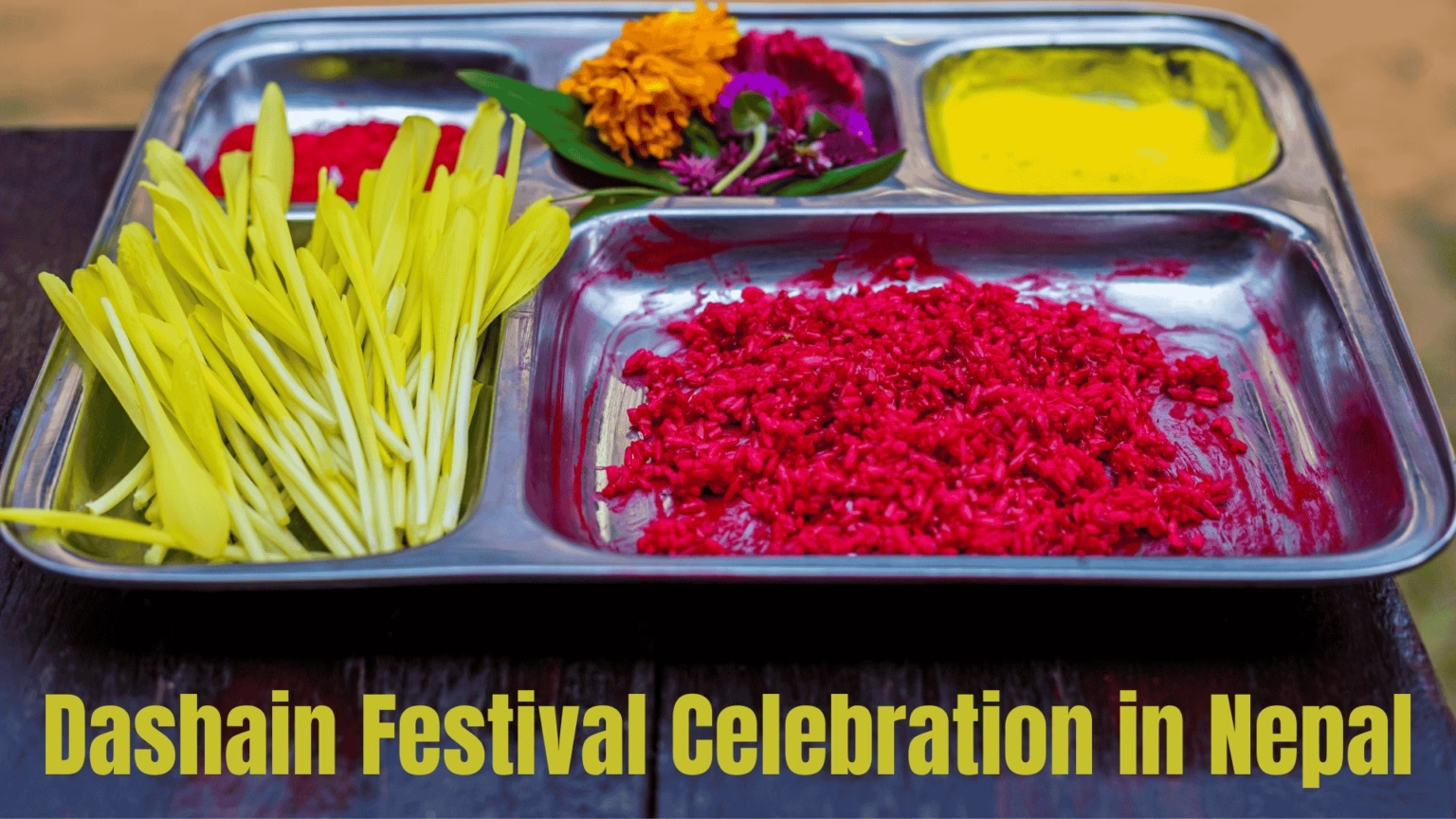
For travelers visiting Nepal in October 2026, experiencing Dashain firsthand is one of the most immersive cultural events in all of South Asia. Dashain 2026 runs from October 11 to October 25, with the pinnacle tika ceremony on October 21. This guide covers the mythology, rituals, key days, regional celebrations, and practical travel insights you need to understand and enjoy Dashain Festival in Nepal.
What Is the Dashain Festival and Why Is It Nepal's Most Important Celebration?
Dashain is a 15-day Hindu festival in Nepal that marks Goddess Durga's victory over the demon Mahishasura, observed through worship, family reunions, tika blessings, animal sacrifice, and communal feasting. It is the longest national holiday in Nepal and the single most culturally unifying event in Nepali society.
Also called Vijaya Dashami or Bijaya Dashami, the festival holds deep religious significance for the Hindu community, which constitutes approximately 81% of Nepal's population. Schools, universities, government offices, banks, and most private businesses close for the festival's final 5 days, with the entire country observing a week or more of celebration.
Dashain is not merely a religious observance. It is a social institution. Nepali people living abroad, in India, Qatar, the United States, Australia, and across the world, return home specifically for Dashain. It is the one time of year when three or four generations of a family gather under one roof, share meals, exchange blessings, and reinforce bonds that define Nepali identity.
The word "Dashain" derives from the Sanskrit "Dasha" (ten), referring to the tenth day of the festival, Vijaya Dashami, which is the most sacred day. The festival's full name in classical usage is Maha Dashain, or the "Great Tenth."
What Is the Mythological Origin and History of Dashain Festival in Nepal?
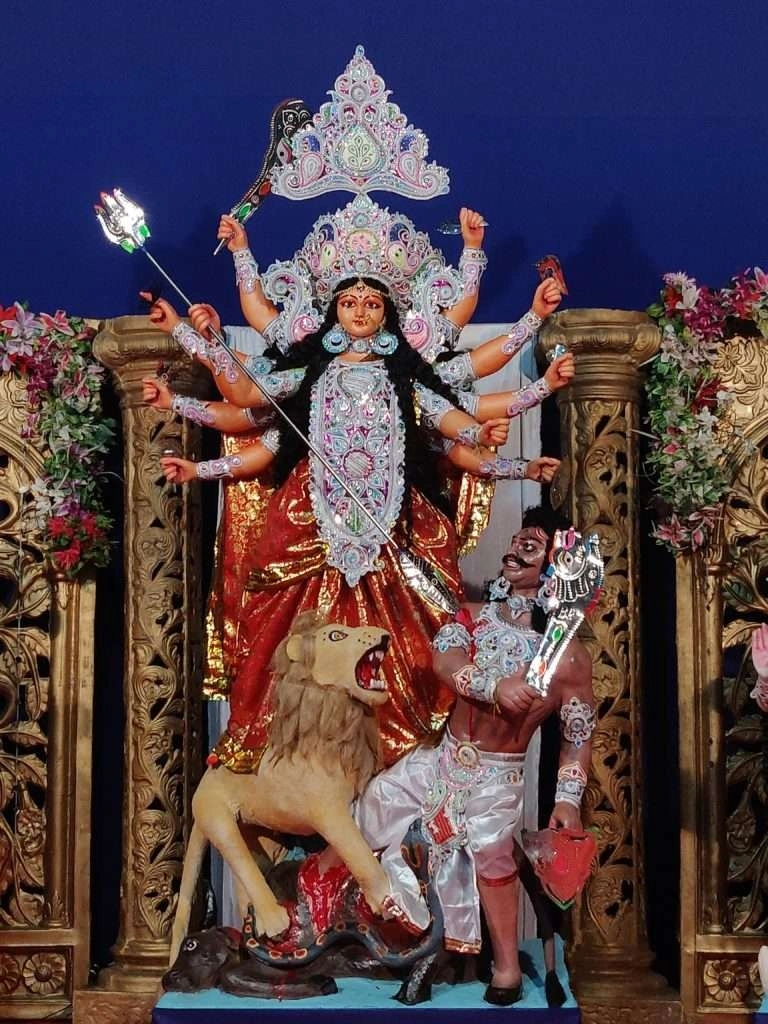
Dashain's mythology originates from the ancient Hindu scripture Devi Mahatmya, which narrates how Goddess Durga, created from the combined divine energy of all gods, defeated the shape-shifting demon Mahishasura after 9 days of relentless battle, restoring cosmic order on the tenth day.
The Story of Goddess Durga and Mahishasura
Mahishasura, whose name means "buffalo demon", had obtained a boon from Lord Brahma making him invincible to any male being. Armed with this power, he terrorized the three worlds, expelled the gods from heaven, and plunged the universe into chaos. The gods, unable to defeat him individually, merged their divine energies to create Goddess Durga: a warrior goddess of supreme power, wielding 10 weapons, one in each arm.
The battle lasted 9 days and 9 nights. On the tenth day, Durga slew Mahishasura. The first 9 days of Dashain, called Navaratri (Nine Nights), commemorate this battle. The tenth day, Vijaya Dashami, celebrates the final victory.
Historical Roots in Nepal's Royal Tradition
Historically, Dashain in Nepal carried deep ties to royalty. The Shah dynasty, which unified Nepal in the 18th century, institutionalized Dashain as a state festival. The Royal Army received tika from the king on Vijaya Dashami as a symbol of royal blessing before battle campaigns. This royal dimension gave Dashain its national character and explains why it is observed as a formal state holiday even in modern Nepal.
The tradition of receiving tika from one's eldest family member, a practice that defines the festival's social meaning, directly mirrors this royal blessing tradition extended into everyday family life.
When Is Dashain Festival Celebrated in Nepal?
Dashain begins on the first day of the bright fortnight (Shukla Paksha) of the Nepali month of Ashwin, which falls between late September and mid-October in the Gregorian calendar, and concludes on the full moon day (Purnima), making the full festival span 15 days.
Key Day | Nepali Name | 2026 Date | Nepali Calendar (2083 BS) |
Day 1 | Ghatasthapana | Sunday, October 11, 2026 | Ashwin 25, 2083 |
Day 7 | Fulpati | Saturday, October 17, 2026 | Ashwin 31, 2083 |
Day 8 | Maha Ashtami | Sunday, October 18, 2026 | Kartik 1, 2083 |
Day 9 | Maha Navami | Monday, October 19, 2026 | Kartik 2, 2083 |
Day 10 | Vijaya Dashami (Tika) | Wednesday, October 21, 2026 | Kartik 4, 2083 |
Day 15 | Kojagrat Purnima | Sunday, October 25, 2026 | Kartik 8, 2083 |
The festival follows the Bikram Sambat (BS) lunar calendar, Nepal's official calendar. Because this is a lunar calculation, the Gregorian date shifts by approximately 10–20 days each year. In 2026, the full Dashain festival runs from October 11 to October 25, with the most auspicious tika muhurat on Vijaya Dashami confirmed at 11:53 AM Nepal Standard Time on October 21, 2026, as determined by the Nepal Panchanga Nirnayak Samiti (Nepal Calendar Determination Committee). Travelers planning a Nepal trip around Dashain 2026 must book flights and accommodation well before mid-October, as demand peaks sharply in the 2 weeks before Vijaya Dashami.
What Are the 5 Most Important Days of Dashain Festival in Nepal?
The 5 most celebrated days of Dashain are Ghatasthapana (Day 1), Fulpati (Day 7), Maha Ashtami (Day 8), Maha Navami (Day 9), and Vijaya Dashami (Day 10), each marked by distinct rituals that escalate in spiritual intensity toward the climactic tika ceremony.
Ghatasthapana: The Sacred Beginning of Dashain
Ghatasthapana, literally "the planting of the holy vessel", marks the official start of Dashain. Performed at a precise auspicious hour (muhurta) determined by astrologers, the ritual involves:
Filling a clay or brass pot (ghata) with holy water, topped with a coconut
Placing the vessel on a bed of sand mixed with soil from 7 sacred locations
Sowing barley or maize seeds directly into the sand
A priest or eldest family member places this vessel in the family puja room (home shrine). For the next 9 days, the seeds germinate in the absence of direct sunlight, producing jamara, pale yellow seedlings that become the sacred grass used on Vijaya Dashami. The sprouting of jamara symbolizes the goddess's presence in the home throughout Navaratri.
Families who maintain a strict observance perform daily puja (worship) at this vessel for all 9 days, offering flowers, incense, and rice to Goddess Durga.
Fulpati: The Procession of Sacred Plants
Fulpati means "sacred flowers and leaves." On the 7th day, a formal state procession, historically originating from Gorkha, the ancestral home of Nepal's Shah dynasty, carries a large bundle of sacred plants including:
Sugarcane stalks (symbolizing abundance)
Banana leaves (representing fertility)
Jamara seedlings (the sprouted barley from Ghatasthapana)
Red tika powder containers
This royal bundle is traditionally delivered to the Hanuman Dhoka Palace in Kathmandu with full military honors. In homes across Nepal, Fulpati is the day when families bring fresh flowers and sacred leaves into their puja rooms to honor the goddess.
Maha Ashtami: The Night of the Goddess Kali
Maha Ashtami, the eighth day, intensifies in spiritual gravity after sunset. The night is called Kal Ratri (the Dark Night), the most intense period of Durga worship.
Animal sacrifice (balidan) is the defining ritual of Maha Ashtami. Buffaloes, goats, ducks, and chickens are sacrificed at Shakti temples across Nepal. The Taleju Temple in Kathmandu's Durbar Square, the royal temple of the Shah kings, opens to the public only once per year on this day. Tens of thousands of devotees wait in line to receive the goddess's blessing.
The sacrificed animals are considered prasad (blessed offerings) and their meat is shared among family members. This practice reflects the tantric tradition of the Shakti cult, which regards Durga in her fierce form, Kali, as requiring blood offerings to be appeased.
Maha Navami: The Worship of Tools, Vehicles, and Crafts
Maha Navami, the ninth day, is unique in its extension of sacred worship beyond the deity to the instruments of human livelihood. On this day:
Mechanics worship their tools and repair equipment
Farmers perform puja on their plows and agricultural implements
Drivers and vehicle owners adorn cars, buses, and trucks with marigold garlands and vermilion, offering prayers for safe journeys
Government offices worship their official equipment
Army and police units perform formal weapon puja
This tradition stems from the same cultural logic as the weapons ceremony performed at the Dashain Kot (armory) adjacent to Hanuman Dhoka Palace, where the Nepalese Army still performs formal sword and firearm puja on Navami. The message is consistent: every tool that enables work and protects life is treated as an extension of divine blessing.
Vijaya Dashami: The Tika Ceremony and Family Reunions
Vijaya Dashami is the 10th and most sacred day of Dashain, when the eldest living family member applies tika, a mixture of red vermilion, rice grains, and yogurt, to the foreheads of younger relatives, along with jamara seedlings and a blessing called Aashirvad. In 2026, Vijaya Dashami falls on Wednesday, October 21, with the official tika muhurat beginning at 11:53 AM Nepal Standard Time.
This ceremony defines Dashain's social heart. Families gather at the home of the eldest member, a grandparent, great-uncle, or patriarch, often traveling hundreds of kilometers to participate. The receiving of tika carries both religious and social weight:
The tika represents Goddess Durga's blessing transmitted through the family elder
Jamara placed behind the ear symbolizes the wish for prosperity
The Dakshina (monetary gift) given alongside tika represents the elder's material blessing to the younger generation
Children receive dakshina from multiple relatives over several days, making Vijaya Dashami a deeply anticipated day. The tika-receiving visits continue for 5 days until Kojagrat Purnima, the full moon.
What Happens During the Full 15 Days of Dashain Navaratri Worship?
During the first 9 days of Dashain (Navaratri), devotees worship 9 different forms of Goddess Durga, one per day, through daily puja, fasting, temple visits, and the growing of jamara seedlings. The 9 forms are: Shailputri, Brahmacharini, Chandraghanta, Kushmanda, Skandamata, Katyayani, Kalaratri, Mahagauri, and Siddhidhatri.
Devout practitioners observe the full 9-day fast (Navaratri vrat), consuming only fruits, milk, and water. Others perform partial fasting or simply maintain daily puja. The most dedicated worshippers visit Shakti pitha temples daily, sacred sites where different manifestations of the Goddess are enshrined.
Nepal has several important Shakti temples that attract massive crowds during Navaratri:
Dakshinkali Temple (Dakshinkali, Kathmandu Valley): the most visited animal sacrifice site in Nepal
Taleju Bhawani Temple (Durbar Square, Kathmandu): the royal goddess temple, open to Hindus only on Maha Ashtami
Nuwakot Bhagwati Temple (Nuwakot district): a major Shakti pitha outside the Kathmandu Valley
Manakamana Temple (Gorkha district): the wish-fulfilling goddess temple accessible by cable car
What Are the Cultural Customs and Traditions of Dashain Festival?
Dashain's 7 most recognized cultural traditions are: the tika-and-jamara ceremony, animal sacrifice (balidan), new clothing for all family members, the gift of dakshina money to children, bamboo swing festivals (ping), kite flying, and communal card-playing (marriage and teen patti).
New Clothing as a Sign of Renewal
Purchasing and wearing new clothes for Dashain is not optional, it is a social obligation. Families begin buying new outfits weeks in advance. Markets in Kathmandu, Pokhara, Biratnagar, and Dharan see a dramatic surge in foot traffic from September onward. The wearing of new clothes on Vijaya Dashami symbolizes a fresh beginning blessed by the goddess.
For households with economic constraints, ensuring children receive new clothes for Dashain takes priority over all other purchases. This cultural imperative makes Dashain the single most commercially significant retail period in Nepal's calendar.
Bamboo Swings (Ping) Across Nepal
Traditional bamboo swings erected in open fields and village squares are a distinctive feature of Dashain, particularly in hilly communities. These large swings, some reaching heights of 6 to 8 meters, are constructed by community members and serve as gathering points for youth and children throughout the festival period.
Swinging during Dashain carries ritual meaning beyond entertainment. According to folklore, the swinging motion was practiced by farmers during the harvest season to invoke the blessings of the goddess. Today, the ping (as the swing is called in Nepali) remains a symbol of Dashain's community spirit and is increasingly rare in urban centers.
Kite Flying During Dashain
Kite flying surges during Dashain across Terai plains and Kathmandu Valley. The skies above Kathmandu fill with hundreds of kites from Ghatasthapana through Vijaya Dashami. Children and adults engage in competitive kite battles, attempting to cut rivals' strings with manja (glass-coated string).
What Is the Significance of Jamara in Dashain Festival?
Jamara are pale yellow seedlings of barley or maize, germinated over the 9 days of Navaratri in the darkness of the family puja room, and placed behind the ears of younger family members by elders during the Vijaya Dashami tika ceremony as a symbol of Goddess Durga's blessing and the family's prayer for agricultural prosperity.
The pale yellow color of jamara results from germination in the absence of sunlight, a deliberate cultivation process mirroring the spiritual incubation of divine energy during Navaratri. Jamara is one of the most visually distinctive symbols of Dashain and immediately recognizable as such during the festival period.
How Is Dashain Festival Celebrated Differently Across Nepal?
Dashain celebrations across Nepal's 3 main geographic zones, the Himalayan highlands, the middle hills, and the Terai plains, share the same core rituals but differ in emphasis, community scale, and regional customs shaped by ethnicity, altitude, and local tradition.
Dashain in the Kathmandu Valley
The Kathmandu Valley centers Dashain around the Taleju Temple complex and Hanuman Dhoka's historic Dashain Kot armory. The Fulpati procession retains its royal ceremonial character even in the republic era. Newari communities in Bhaktapur, Patan, and Kathmandu conduct parallel festivals honoring Kumari (the Living Goddess) alongside Durga worship.
Dashain in the Hilly Districts
Mountain and hill communities celebrate Dashain with strong agricultural connections. Village festivals incorporate communal feasts, bamboo swings, and extended family gatherings that last for the full 5-day tika period. The scale of animal sacrifice is largest in hill communities with strong Khas-Arya and Rai/Limbu cultural traditions.
Dashain in the Terai
Terai communities, including Madhesi, Tharu, and immigrant hill communities, observe Dashain alongside regional harvest traditions. Kite flying is most common in Terai cities. The festival integrates with the parallel Indian Dussehra celebrations visible across the open Nepal-India border.
What Should Travelers Know About Visiting Nepal During Dashain Festival?
Travelers visiting Nepal during Dashain must plan for 4 specific realities: business closures during the final 5 days, reduced trekking porter availability, heightened accommodation demand in Kathmandu, and exceptional cultural access to rituals and temples that are otherwise restricted or less active.
What Closes During Dashain in Nepal?
During Vijaya Dashami and the 4 following tika days, the following services operate at reduced capacity or fully close:
Government offices, banks, and embassies (closed for 5+ days)
Most locally owned restaurants and shops (closed for 3–5 days while owners return to hometowns)
Schools and universities (closed for 2–3 weeks in some cases)
Domestic trekking service operators (many staff return home for family tika)
International hotels, major tourist restaurants in Thamel, and airline services continue to operate. Travelers who prefer independent trekking without a guide face fewer logistical challenges than those requiring full porter-and-guide services during Dashain.
What Remains Open and Accessible?
The temple complex at Pashupatinath in Kathmandu remains fully active throughout Dashain, hosting continuous puja and animal sacrifice in the adjacent Slaughterhouse square. Boudhanath Stupa and Swayambhunath Stupa retain normal visiting hours. The Dashain Kot military ceremony at Hanuman Dhoka on Maha Navami is one of Nepal's most dramatic public events and is accessible to visitors.
Practical Booking Advice for Dashain Travel
Travelers booking Kathmandu hotels for the October 18–25, 2026 Vijaya Dashami week experience sharp price increases and reduced availability. Book accommodation at least 6–8 weeks in advance, ideally by early September 2026. Domestic flights from Kathmandu to Pokhara, Lukla, and Bharatpur fill quickly in the 5–7 days before October 21. Confirm flight bookings early if regional travel is part of your 2026 itinerary.
If your goal is trekking in Nepal, routes that begin after Vijaya Dashami typically see full service restoration. Routes starting 3–5 days before Vijaya Dashami may have staffing gaps.
How Does Dashain Compare to Tihar, Nepal's Other Major Festival?
Dashain and Tihar are Nepal's 2 most important Hindu festivals. Dashain lasts 15 days and emphasizes Goddess Durga, family reunions, tika blessings, and animal sacrifice. Tihar follows 20–25 days later, lasts 5 days, centers on Goddess Lakshmi, and is characterized by oil lamps, flower garlands (rangoli), and the worship of crows, dogs, cows, and brothers.
The two festivals together form the high season of Nepali Hindu observance. Where Dashain is the festival of family hierarchy and ancestral blessing, Tihar is the festival of light, beauty, and the worship of the connections between living beings and their divine counterparts.
For travelers, experiencing both Dashain and Tihar in a single trip, which is entirely possible given the 3–4 week gap between them, offers the most complete picture of Nepal's Hindu ceremonial calendar.
What Is the Spiritual Message of Dashain Festival for Nepal?
Dashain's spiritual core is the declaration that truth, righteousness, and collective divine power overcome even the most entrenched evil, a message that Nepali society renews each year through 15 days of worship, reunion, and ceremony.
The festival also carries a harvest thanksgiving dimension. Dashain falls immediately after the major rice harvest across Nepal's agricultural heartland. The abundance of food, particularly the ritual consumption of meat, often the single most lavish meal of the year for rural families, reflects the ancient integration of agricultural cycles with religious celebration.
The tika ceremony itself encodes this message personally. When an elder places tika on a younger family member's forehead, they transmit a specific blessing (Aashirvad): long life, victory over obstacles, and continued prosperity. Every participant in the ceremony, both giver and receiver, re-enacts the mythological moment when the gods transferred their power to Durga to overcome what they could not defeat alone.
When is Dashain 2026 in Nepal?
Dashain 2026 begins on Sunday, October 11, 2026 (Ghatasthapana) and concludes on Sunday, October 25, 2026 (Kojagrat Purnima). The most important day, Vijaya Dashami (Tika Day), falls on Wednesday, October 21, 2026, with the auspicious tika muhurat at 11:53 AM Nepal Standard Time, as confirmed by the Nepal Panchanga Nirnayak Samiti. According to the Nepali calendar, this corresponds to Ashwin 25 – Kartik 8, 2083 BS. Tika is a mixture of red vermilion (sindur), rice, and yogurt applied to the forehead during Vijaya Dashami. It represents Goddess Durga's blessing transmitted from elder to younger family member. The red color signifies Shakti (divine feminine power), the rice grains represent abundance, and the yogurt symbolizes purity.
Is Dashain only celebrated by Hindus?
Dashain is primarily a Hindu festival, but in Nepal it functions as a national celebration. Buddhist Newars of the Kathmandu Valley participate in modified forms. Many Nepali Christians and those of other faiths participate in the cultural aspects, receiving tika from family elders, while observing their own religious practices separately.
Can foreigners participate in Dashain rituals?
Foreigners can observe most Dashain rituals at public temples and in street processions. Receiving tika from a Nepali family that extends the invitation is considered respectful and is warmly welcomed. Entering the inner sanctums of Hindu-only temples such as Taleju is restricted to Hindus.
What foods are traditionally eaten during Dashain?
The primary foods of Dashain are sel roti (a sweet fried rice-flour bread), khasi ko masu (goat meat curry), beaten rice (chiura), homemade yogurt, and various vegetable dishes. The meat feast on and after Vijaya Dashami is one of the year's most anticipated meals for Nepali families.
What does Dashain mean for Nepal's economy?
Dashain is Nepal's single largest domestic consumer spending period. Government employees receive a Dashain bonus (equivalent to one month's salary) before the festival. Retail, transportation, garment, and food sectors experience their peak sales weeks in the run-up to Vijaya Dashami.
Plan Your Visit to Nepal During Dashain Festival
Dashain Festival in Nepal offers a depth of cultural experience unmatched by most events in the Himalayan region. From the quiet devotion of Ghatasthapana to the electric atmosphere of Maha Ashtami temple processions and the deeply personal tika ceremony of Vijaya Dashami, the festival reveals the full spectrum of Nepali spiritual life, family values, and cultural pride.
Dashain 2026 key dates at a glance:
Ghatasthapana: October 11, 2026
Fulpati: October 17, 2026
Maha Ashtami: October 18, 2026
Maha Navami: October 19, 2026
Vijaya Dashami (Tika): October 21, 2026 at 11:53 AM NST
Kojagrat Purnima: October 25, 2026
Travelers who time their Nepal visit to coincide with Dashain 2026 gain access to a living tradition that textbooks and documentaries cannot replicate. The smell of incense, the sound of dhol drums at temple squares, the sight of families in new clothes carrying jamara seedlings, these are experiences that define Nepal as a destination unlike any other.
If you are planning a Nepal trekking or cultural tour around the Dashain 2026 season, connect with Nepal Intrepid Treks with the festival schedule to design an itinerary that gives you the best possible cultural access while ensuring your trekking logistics remain intact.
.avif&w=1920&q=75)
.avif&w=1920&q=75)