Short hikes in Nepal offer some of the most rewarding Himalayan experiences without the time commitment of long expeditions like the Everest Base Camp Trek or Annapurna Circuit. Ranging from easy one-day walks near Kathmandu to rewarding five to seven-day mountain adventures, these trails combine panoramic Himalayan viewpoints, traditional villages, ancient monasteries, rhododendron forests, alpine ridges, and authentic teahouse culture. Whether your goal is watching sunrise over the Annapurna range from Poon Hill, exploring the peaceful ridges of Mohare Danda, reaching the dramatic Mardi Himal Viewpoint, or discovering lesser-known trails like Ama Yangri and Pikey Peak, Nepal provides exceptional short trekking experiences for every fitness level, travel style, and itinerary.
This guide compares the 10 best short hikes in Nepal based on scenery, trekking duration, altitude, difficulty, accessibility, seasonal conditions, permits, and overall experience. From beginner-friendly hikes such as Australian Camp, Nagarkot, and Chisapani to higher-altitude adventures including Langtang Valley, Khopra Danda, and Mardi Himal, you'll learn what makes each trail unique, who it is best suited for, and how to choose the right hike based on your available time, trekking experience, and mountain goals. By the end of this guide, you'll have a clear understanding of which short Himalayan hike delivers the experience you're looking for while making the most of your journey in Nepal.
1. Poon Hill
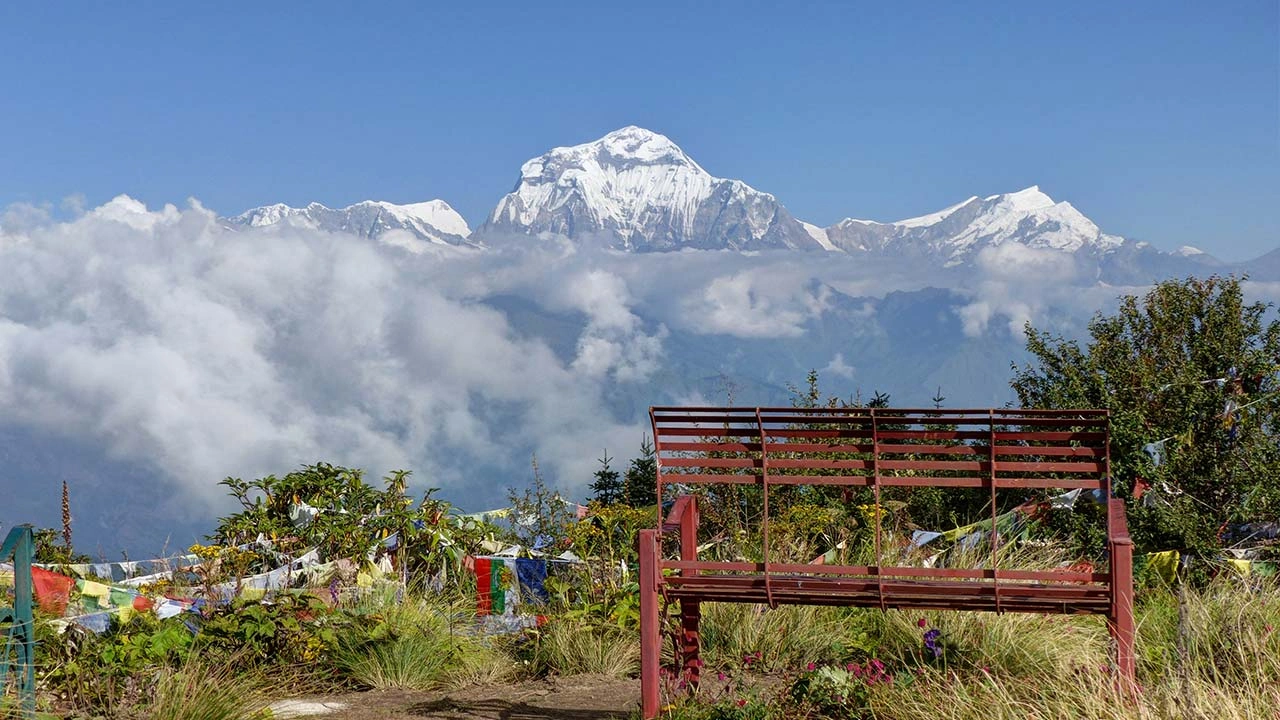
Poon Hill (3,210m) is Nepal's most famous short trek, offering a stunning sunrise panorama of Annapurna, Dhaulagiri, and Machapuchare. The 4-day hike starts from Nayapul, just 2 hours from Pokhara. It's suitable for beginners with no prior altitude experience. Best visited in October–November or March–April for rhododendron blooms.
What Makes Poon Hill Famous?
Poon Hill sits at 3,210 metres in the Annapurna region and remains one of the most photographed sunrise viewpoints in all of Asia. At dawn, a 360-degree sweep of the western Himalaya unfolds above a sea of cloud: Annapurna South, Dhaulagiri, Hiunchuli, Machapuchare (Fishtail), and on clear mornings, the distant white silhouette of Dhaulagiri I at 8,167 metres.
What separates Poon Hill from other famous viewpoints is the quality of the mountain cross-section it offers. Because the Annapurna massif curves around the viewpoint in a horseshoe shape, you see multiple high peaks simultaneously across a single wide horizon, something even more celebrated viewpoints like Nagarkot can't match.
The trail is part of the Ghorepani-Poon Hill circuit, which begins in Nayapul (accessible by a two-hour drive from Pokhara) and passes through Tikhedhunga, Ulleri, and Ghorepani before the final ascent to Poon Hill. The famous stone staircase climb to Ulleri (3,400+ steps) is the section most trekkers remember, a punishing but strangely satisfying ascent through oak and rhododendron forest.
An important detail that most guides gloss over: the Poon Hill summit is reached via a 45-minute early morning ascent from Ghorepani. Most trekkers start this pre-dawn push at 4:30–5:00 AM with a headlamp, meaning the quality of your headlamp and your readiness for cold mountain mornings (temperatures regularly drop to -5°C in the pre-dawn hours, even in spring) matters more than people anticipate.
What Should You Know Before Hiking to Poon Hill?
The Poon Hill hike is generally considered easy to moderate, making it suitable for trekkers with no prior high-altitude experience. That said, there are a few practical realities worth knowing before you go.
Permits required: You need two permits, the E-TIMS Card (Trekkers' Information Management System) and the ACAP permit (Annapurna Conservation Area Permit). Under Nepal's mandatory guide policy, foreign trekkers can no longer hike independently, both permits must be processed through a registered trekking agency when you hire your licensed guide, per the Nepal Tourism Board's mandatory-guide requirement, first introduced April 1, 2023 and now fully enforced.
Crowd management: Poon Hill is Nepal's most trafficked short hike, and the summit viewpoint can be busy during the October–November and March–April peak seasons. If solitude matters to you, consider arriving at the summit 30 minutes before other trekkers or opting for a weekday start.
Ideal duration: 4 days (Nayapul → Ulleri → Ghorepani → Poon Hill → Tadapani → Ghandruk → Nayapul) gives a fuller experience. A compressed 3-day version skips Tadapani and Ghandruk but still delivers the signature sunrise.
Best season: Mid-September to November, and March to May for rhododendron blooms. The forest between Ghorepani and Tadapani turns vivid red and pink in March, a detail worth timing your visit around.
2. Australian Camp
Australian Camp (2,060m) is a quiet, one to two-day hike from Pokhara with sweeping Annapurna range views. The trail starts at Kande and takes around 3 hours of steady uphill walking. It's beginner-friendly and works perfectly as a day hike from Pokhara. Visit October–November for the clearest mountain visibility.
What Can You Expect on the Australian Camp Hike?
At 2,060 metres, Australian Camp sits on a ridge above Pokhara with an almost theatrical view of the Annapurna and Manaslu ranges. The name traces back to an Australian aid project that operated in the area decades ago, and the destination has retained a quiet, unhurried character that distinguishes it from the more commercial Poon Hill circuit.
The standard trail begins at Kande, a small roadhead about 45 minutes from Pokhara by taxi or local bus. From there, the hike climbs steadily through Gurung villages, terraced fields, and rhododendron patches to the camp in approximately 2.5–3 hours. The uphill is consistent rather than steep, and the trail surface is well-maintained, making it genuinely approachable for first-time trekkers in reasonable fitness.
What competitors often undersell about Australian Camp is the foreground quality of its Himalayan views. Because the ridge drops sharply toward the Pokhara valley below, you get both the full Annapurna panorama above and the bowl of Pokhara's lakes and city spread out beneath you, a two-direction view that feels unusually cinematic.
The camp itself has several teahouses where overnight stays are popular. Watching the alpenglow turn Annapurna South deep orange at sunset, then catching it again at sunrise, is a significantly different experience from the purely dawn-focused Poon Hill visit.
When Is the Best Time to Visit Australian Camp?
Australian Camp is a year-round hike with clear distinctions between seasons. October and November offer the crispest mountain visibility, lowest cloud cover, and stable weather, these are peak months for good reason. March and April rival autumn for views and add rhododendron colour to the trail.
The monsoon months (June–August) create a striking green landscape, but cloud cover substantially reduces mountain views. The trail itself becomes slippery with rain; leeches are active on this section. December through February sees snow possible above 2,000 metres on cold nights, and mornings can be very cold, but clear winter skies sometimes produce the sharpest Himalayan visibility of the year.
A practical insight most guides omit: the Australian Camp hike is short enough (3–4 hours round trip at a comfortable pace) to work as a day hike from Pokhara, start early, reach the camp by mid-morning for peak mountain clarity, have lunch at a teahouse, and return to Pokhara by early afternoon. This flexibility makes it one of the best options for trekkers with only a single full day to spare in the Annapurna region.
3. Nagarkot
Nagarkot (2,175m) is the closest Himalayan viewpoint to Kathmandu, just 32km away. On clear mornings, you can see over 200km of peaks including distant Everest. It's an easy hike or short drive, ideal for trekkers with limited time. October and February deliver the sharpest mountain clarity.
What Views Can You Enjoy from Nagarkot?
Nagarkot at 2,175 metres is the Kathmandu Valley's answer to a Himalayan viewpoint. On clear days, most reliable in October–November and again in February–March, the panorama from Nagarkot stretches across roughly 200 kilometres of Himalayan skyline, taking in peaks from Dhaulagiri in the west to Kanchenjunga in the east, with Mount Everest (officially measured at 8,848.86 metres by the Survey Department of Nepal's official height-measurement study) visible as a distant pyramid in the northeast.
The view from Nagarkot rewards patience and timing. Mountain clarity here is highly weather-dependent; mornings consistently outperform afternoons, and the post-monsoon season delivers the most reliable sightlines. Many trekkers who visit midday in the wrong season see only cloud, while those who spend the night and rise for sunrise are far better positioned.
Beyond the famous eastern panorama, Nagarkot also looks down into the Bhaktapur valley, offering a contrast between the ancient red-brick architecture of one of Nepal's finest medieval cities and the permanent ice of the high Himalaya, visible in the same moment.
How Difficult Is the Nagarkot Hike?
Nagarkot is one of the most beginner-friendly day hikes from Kathmandu, making it a logical first mountain experience for trekkers who've just arrived in Nepal. The village is accessible by road from Kathmandu (about 32 kilometres east, 1.5–2 hours by taxi), so it works as a drive-up destination. However, the most rewarding approach is the walking route from Bhaktapur, which adds approximately 3–4 hours of gradual uphill hiking through terraced farmland and rural villages.
Difficulty is low: steady elevation gain but no technical terrain, well-marked trails, and multiple teahouses along the route. Altitude-related symptoms are rare at 2,175 metres but possible for trekkers arriving directly from sea level, the first night especially can bring mild headaches for some people.
What most short guides don't mention: the hike from Nagarkot to Changunarayan Temple (a 4–5 hour walk downhill) is an outstanding extension that combines the mountain viewpoint with one of Nepal's oldest and most historically significant Hindu temples, a UNESCO World Heritage site. If your itinerary allows a full day in the area, this combination offers cultural depth that a simple Nagarkot sunrise stop misses entirely.
4. Chisapani
Chisapani (2,215m) is a classic 2-day hike starting from Sundarijal, 30 minutes from Kathmandu. The trail passes through Shivapuri Nagarjun National Park with rich birdlife and dense forest. From the ridge, you get clear views of the Langtang and Jugal Himalayan ranges. It can also be extended to Nagarkot for a rewarding 4–5 day ridge walk.
What Highlights Will You Experience on the Chisapani Trail?
Chisapani at 2,215 metres is a two-day classic that most Kathmandu-based trekking agencies recommend for good reason: it's close (trailhead at Sundarijal, 30–45 minutes from Thamel), sits inside the Shivapuri Nagarjun National Park, and the Chisapani Nagarkot hike delivers panoramic Langtang range views from the ridge.
The trail climbs through dense pine and rhododendron forest, passes the Shivapuri peak ridgeline, and arrives at Chisapani village, a collection of teahouses perched on an open ridge with Langtang Lirung (7,227 m), Ganesh Himal, and the Jugal Himal clearly visible on clear mornings.
What makes Chisapani genuinely interesting from a hiking perspective (beyond the views) is the forest quality. The Shivapuri-Nagarjun National Park is one of the most biodiverse areas within 20 kilometres of any Himalayan capital city, home to 320 recorded bird species and 65 mammal species, per the official Shivapuri Nagarjun National Park management plan. Birders regularly encounter black-capped laughingthrushes, red-billed magpies, and, during migration seasons, rare Himalayan species. If you carry binoculars, the forest section rewards a slow, attentive pace.
The Chisapani overnight experience also deserves credit. Ridge sunsets here turn the entire Langtang massif deep amber, and the village is small enough that you'll often share the viewpoint with only a handful of other trekkers, a stark contrast to the more popular Nagarkot.
How Can You Combine Chisapani with Other Nearby Hikes?
Chisapani sits at the start of a longer multi-day loop that extends to Nagarkot, creating a popular 4–5 day ridge walk entirely within or adjacent to Shivapuri-Nagarjun National Park. The Chisapani–Nagarkot trail passes through Chisapani, Golphubhanjyang, Thakre, and Nagarkot, maintaining elevation between 1,800 and 2,400 metres throughout and staying in forest for much of the distance.
For trekkers with just two days, the standard Sundarijal–Chisapani–Sundarijal loop is the most commonly chosen option. But for anyone with an extra day or two, extending to Nagarkot and returning to Kathmandu via Bhaktapur (described under the Nagarkot section above) creates a genuinely compelling self-contained trek within striking distance of the capital.
5. Mardi Himal Viewpoint
.avif)
Mardi Himal Base Camp (4,500m) sits directly beneath Annapurna South for a dramatically close mountain experience. The 4–5 day trek from Kande is less crowded than Poon Hill but more demanding. The trail climbs through bamboo and rhododendron forest into open alpine terrain. March–April is ideal when the rhododendron forest below High Camp is in full bloom.
What Makes the Mardi Himal Viewpoint Trail Unique?
Mardi Himal Base Camp at approximately 4,500 metres is one of the most scenically dramatic short treks in the Annapurna region, and still dramatically less crowded than Poon Hill or the Annapurna Base Camp trail. The trek sits on the eastern ridge of the Mardi Himal massif, pushing through bamboo forest, rhododendron jungle, and exposed alpine terrain before arriving at a high-camp viewpoint that looks directly into the faces of Annapurna South, Hiunchuli, Mardi Himal, and Machapuchare.
The defining characteristic of the Mardi Himal trail is the intimacy of the mountain views. While Poon Hill offers an impressive wide panorama, Mardi Himal places you on a narrow ridge directly below the peaks, the sensation is of being enclosed by the mountains rather than observing them from a distance. Many experienced trekkers who have done both describe Mardi Himal as the more visceral experience.
The Mardi Himal trek begins from Kande (shared starting point with Australian Camp) or from Lwang Ghalel village, climbing through increasingly dramatic vegetation zones. The section above High Camp to the viewpoint ridge is steep, exposed, and demanding, this is not a casual walk even by short-trek standards.
How Many Days Do You Need for the Hike?
Most trekkers complete Mardi Himal in 4 to 5 days: Kande or Pokhara to Forest Camp (Day 1), Forest Camp to Low Camp or High Camp (Day 2), High Camp to Mardi Himal Base Camp viewpoint and back to High Camp (Day 3), descent via Siding village (Day 4), and return to Pokhara (Day 5).
A compressed 3-day version exists but involves long hiking days and limits acclimatisation time at altitude, not recommended for trekkers with no prior high-altitude experience.
One critical planning detail: the upper trail above Low Camp can be snowbound from December through February, making a 4WD to Kande and good warm layers non-optional in winter. Spring (March–April) is the most popular season specifically because the rhododendron forest between Forest Camp and Low Camp is in full bloom, dense red, pink, and white flowering canopy at precisely the altitude where you need it most.
6. Mohare Danda
Mohare Danda (3,300m) is an off-the-beaten-path ridge with panoramic views of Dhaulagiri, Annapurna, and Machapuchare. The 4–5 day trek runs on a community-based tourism model where profits stay in local villages. Its rhododendron forests are among the finest in the entire Annapurna region. It can be combined with Poon Hill for a rewarding 6–7 day circuit.
What Makes Mohare Danda Different?
Mohare Danda at 3,300 metres is the trail that rewards curiosity. Less known than Poon Hill, less promoted than Mardi Himal, it sits on a community-owned ridge in the Myagdi district and offers a Himalayan panorama that holds its own against any viewpoint in Nepal: Dhaulagiri, Annapurna South, Annapurna I, Nilgiri, Hiunchuli, and Machapuchare all visible from a single ridge.
What genuinely distinguishes Mohare Danda is its community-based tourism model. The teahouses and lodges on the ridge are owned and operated by local community organisations, not outside investors or Kathmandu-based companies. Profits remain in the village. The food tends to be more homestyle, the interaction more genuine, and the overall experience less transactional than on the busier Annapurna trails.
The rhododendron forests below the ridge are considered among the finest in the Annapurna region. At peak bloom in late March and early April, the trail between 2,500 and 3,000 metres becomes a tunnel of red rhododendron, some trees centuries old. This section alone justifies the trip during spring.
What Can You Expect Along the Trail?
The typical Mohare Danda trek begins from Nayapul (also the starting point for Poon Hill), diverges from the Ghorepani route before Tikhedhunga, and climbs through Ramche and Dobang villages before reaching the Mohare Danda ridge. Total trek duration: 4 to 5 days including return.
Teahouse quality has improved significantly over the past several years, with community lodges now offering comfortable rooms and increasingly diverse menus. You should still expect basic mountain accommodation rather than guesthouse-style rooms, but standards are higher than many trekkers anticipate based on the area's less-commercialised reputation.
An underappreciated practical advantage: because Mohare Danda shares a starting point with Poon Hill, the two destinations can be combined into a single circuit, hiking out via Nayapul, ascending to Ghorepani and Poon Hill, traversing the ridge to Mohare Danda, and returning via a different route. This 6–7 day loop gives trekkers two distinct viewpoints and a far more complete picture of the western Annapurna foothills.
7. Pikey Peak
Pikey Peak (4,065m) in Solukhumbu offers one of Nepal's finest Everest viewpoints, endorsed by Sir Edmund Hillary himself. The 4–5 day moderate trek passes through authentic Sherpa villages far from the crowded Everest trail. Sunrise from the summit reveals Everest, Lhotse, Makalu, and Kanchenjunga in one sweep. Access is via a short flight to Phaplu or a long road journey from Kathmandu.
Why Is Pikey Peak Known for Himalayan Sunrise Views?
Pikey Peak at 4,065 metres in the Solukhumbu district holds an extraordinary distinction: Sir Edmund Hillary reportedly called it one of the finest viewpoints in Nepal for observing Everest. That claim has resonated through the trekking community for decades, and the reality lives up to it.
From Pikey Peak's summit, you look north into a vast white wall of the eastern Himalaya: Mount Everest, Lhotse, Makalu, Cho Oyu, Kanchenjunga, and multiple Khumbu-area peaks all visible simultaneously in a single unbroken sweep. The geometry here is unusual, Pikey Peak's position relative to Everest provides a clearer, less obstructed sightline than many closer viewpoints.
The trail also passes through authentic Sherpa villages that see far fewer tourists than the Everest Base Camp corridor. This means interactions feel genuinely unhurried, guesthouses retain their local character, and you'll often encounter landscapes, yak pastures, juniper forests, mani stone walls, that feel untouched by the commercialisation that has changed parts of the Khumbu region.
What Is the Difficulty Level of the Pikey Peak Trek?
A guided Pikey Peak trek is moderate and accessible to reasonably fit trekkers without prior high-altitude experience. The route typically begins from Phaplu or Salleri (accessible by short flight from Kathmandu or by road via Solu Khumbu), climbs through Jhapre, Pikey Base Camp, and reaches the summit.
Total duration: 4 to 5 days for a round trip that includes the summit push and descent.
The altitude gain is real, from approximately 2,400 metres at trailhead to 4,065 metres at the summit, but the ascent is spread over multiple days with manageable daily elevation gains. The final push to the summit from the base camp can be cold and windy; starting before 5:00 AM for the sunrise view is standard practice.
The key access consideration: Pikey Peak is in the Solu Khumbu region, requiring either a short domestic flight to Phaplu or an 8 to 10-hour scenic jeep journey from Kathmandu via Salleri. The flight option (weather permitting) is far preferable for most trekkers.
8. Khopra Danda
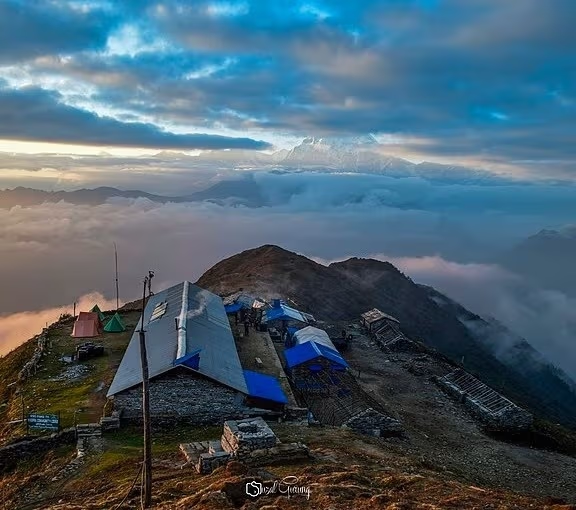
Khopra Danda (3,660m) is a quiet Annapurna ridge trail with dramatic close-up views of Annapurna South and Dhaulagiri. The 5–7 day trek extends to the sacred Khayer Lake at 4,500m, a striking glacial tarn. It's one of the last genuinely uncrowded trails in the Annapurna Conservation Area. The route can be combined with Poon Hill for a fuller western Annapurna experience.
What Makes Khopra Danda Worth Visiting?
Khopra Danda (also called Khopra Ridge) reaches 3,660 metres and occupies one of the most visually commanding positions in the Annapurna region. The ridge puts you within dramatic proximity of Annapurna South (7,219 m) and Dhaulagiri (8,167 m), and on very clear days, the Annapurna I summit is visible to the northeast.
The extension to Khayer Lake at 4,500 metres is Khopra Danda's signature add-on and one of the most rewarding high-altitude lake walks in the Annapurna Conservation Area. The lake is considered sacred by local communities, and the setting, a dark glacial tarn enclosed by rock and snow with Dhaulagiri looming above, is genuinely striking.
Beyond the scenery, Khopra Danda matters to the thoughtful trekker because it represents one of the few remaining truly quiet trails in a region that has become significantly busier since 2015. Most trekkers who do the Annapurna circuit or Poon Hill never venture this far south on the ridge, leaving Khopra as a preserve of those willing to take a slightly less obvious route.
What Should You Know Before Planning the Trek?
Khopra Danda typically takes 5 to 7 days from Nayapul, making it the longest route on this list. A well-paced Khopra Hill trek keeps daily hiking distances manageable, sharing the initial trail with Poon Hill before diverging toward Swanta village and ascending to the Khopra ridge.
Teahouse infrastructure is in place but limited compared to the main Annapurna routes, plan your accommodation in advance during peak season. Water on the upper ridge can be limited; carry more than you think you'll need above Swanta.
One practical planning note: this trek can be combined with Poon Hill in a single 7–8 day itinerary (Poon Hill first, then south along the ridge to Khopra Danda) for trekkers who want to maximise their time in the western Annapurna region. Nepal Intrepid Treks has refined this combined itinerary over multiple seasons; contact us if you'd like the detailed day-by-day breakdown.
9. Ama Yangri
Ama Yangri (3,771m) is an underrated 2-day hike in the Helambu region northeast of Kathmandu. The summit delivers views of Langtang Lirung, Dorje Lakpa, and on clear days, the Everest group. The trail passes through Hyolmo villages and small monasteries rarely visited by tourists. It's one of the best winter hiking options near Kathmandu due to its south-facing, drier aspect.
What Can You Experience on the Ama Yangri Hike?
Ama Yangri at 3,771 metres is a peak in the Helambu region northeast of Kathmandu, and it's one of the most underrated single or two-day hikes accessible from the capital. The summit viewpoint delivers a compelling eastern Himalayan panorama: Langtang Lirung, Dorje Lakpa, Jugal Himal, and on very clear days, the Everest group visible in the far east.
The trail begins from Melamchi Pul Bazar or Timbu and ascends through Tamang and Hyolmo villages, passing small monasteries and prayer flag ridges before reaching the open summit. The cultural texture of the trail is distinct from the Annapurna region, Ama Yangri sits in the heartland of Hyolmo (Helambu Sherpa) communities, and the monasteries, festivals, and cultural practices here differ meaningfully from the more-visited trekking corridors.
The summit itself is considered sacred, a small monastery and prayer flags mark the top, and local tradition holds that the peak is the home of a protective female deity. Trekkers are asked to observe respectful behaviour at the summit, including avoiding loud music, refraining from meat consumption on the final approach, and not disturbing ritual objects.
When Is the Best Season to Visit Ama Yangri?
Ama Yangri has a useful seasonal quirk: because the trail approaches from the south and east, it retains drier, clearer conditions in winter than many north-facing routes. December through February often offer outstanding mountain clarity, making Ama Yangri one of the best winter hiking options in the Kathmandu region.
Autumn (October–November) remains the prime season for overall trail conditions, warmth, and visibility. Spring (March–May) is good but cloud build-up becomes more common by April. Monsoon season (June–August) brings lush green landscapes and near-total mountain cloud cover.
Total trekking time: the most common version is 2 days (Melamchi to Timbu or upper Hyolmo villages, then summit push and return). A one-day option exists for very fit, fast hikers starting extremely early, but the two-day approach gives far more time to engage with the communities and cultural sites along the route.
10. Langtang Valley Trek
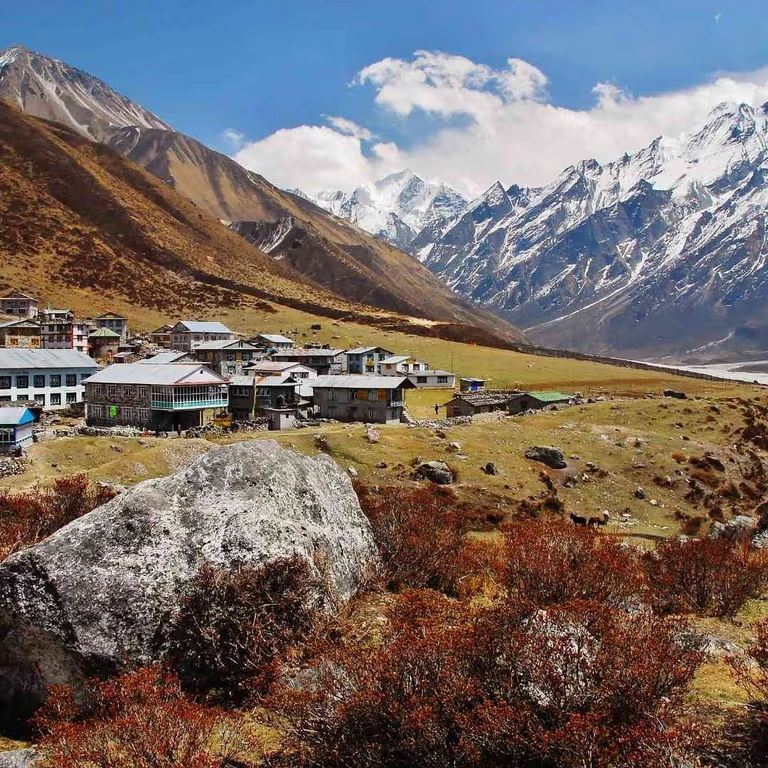
The Langtang Valley Trek leads to Kyanjin Gompa (3,870m) with towering views of Langtang Lirung directly above. The 7–8 day moderate trek also includes an optional ascent of Kyanjin Ri (4,773m) for even broader panoramas. The trail carries deep significance as the region rebuilt after the devastating 2015 earthquake. A yak cheese factory at Kyanjin Gompa is one of the most unique Himalayan highlights on any short Nepal trek.
What Are the Main Highlights of the Langtang Valley Trek?
The Langtang Valley trek leads to Kyanjin Gompa at 3,870 metres and stands as one of the most comprehensively rewarding short treks in the Himalaya. The valley runs due north from the roadhead at Syabrubesi, climbing between increasingly dramatic walls of glaciated rock and ice until the path opens into the broad, windswept Langtang Valley proper.
Key highlights include Langtang Lirung (7,227 m), which towers directly above the valley floor with almost vertical north-facing cliffs; the Langtang Glacier, visible and accessible from Kyanjin Gompa; Kyanjin Ri (4,773 m), an optional summit above the gompa that rewards even stronger views; and the centuries-old Kyanjin Gompa monastery, still active and central to local Tamang Buddhist community life.
The Langtang Valley has a specific historical dimension that should not be glossed over. In April 2015, the region was devastated by the Gorkha earthquake and an associated avalanche, documented in detail by ICIMOD's field assessment of the Langtang avalanche, that destroyed the village of Langtang entirely. The rebuilt trail and communities represent remarkable resilience, trekking here today directly supports the recovery and ongoing livelihoods of Tamang families who rebuilt their lives after profound loss.
The cheese factory at Kyanjin Gompa, still operating and producing yak cheese, butter, and yoghurt, is a highlight for most trekkers and one of the more unusual Himalayan experiences on any short trek in Nepal.
How Challenging Is the Langtang Valley Trek?
Langtang is rated moderate, but the rating conceals meaningful elevation change. The trail from Syabrubesi (1,462 m) to Kyanjin Gompa (3,870 m) gains over 2,400 metres, and acclimatisation must be managed carefully. A well-paced itinerary does not rush the ascent.
Recommended duration: 7 to 8 days (Kathmandu to Syabrubesi by bus or jeep, 6–7 hours; then 3–4 days up the valley; 2–3 days back). A 5-day compressed version is possible but reduces acclimatisation time and eliminates the rewarding Kyanjin Ri side hike.
Permits required: Langtang National Park Permit (NPR 3,000 for foreign nationals as of 2026, per DNPWC's official Langtang National Park brochure, plus the E-TIMS Card. Because solo trekking is prohibited, these must be arranged through your trekking agency alongside your mandatory licensed guide.
The road to Syabrubesi (the trailhead) is long and winding, the bus journey from Kathmandu takes 6–8 hours depending on road conditions. Many trekkers find the road approach more tiring than the hike itself; budgeting a rest afternoon on arrival in Syabrubesi before beginning the trail the following morning is a widely recommended strategy.
How Can You Choose the Best Short Hike in Nepal for Your Travel Style?
With ten genuinely strong options across the list, the right choice depends on three variables more than any others: available days, fitness level, and what the hike is for.
If you have 1–2 days from Kathmandu: Nagarkot, Chisapani, or Ama Yangri. All three are accessible without a domestic flight and deliver real mountain experience.
If you have 3–4 days from Pokhara: Australian Camp or Poon Hill. The Ghorepani Poon Hill trek delivers the definitive Annapurna sunrise classic; Australian Camp offers something quieter with more flexibility.
If you want off-the-beaten-path: Mohare Danda, Pikey Peak, or Khopra Danda. All three see significantly fewer trekkers than the headline trails and reward the extra planning required.
If you want the most dramatic mountain proximity: Mardi Himal Viewpoint or Langtang Valley. Both place you in the midst of the mountains rather than observing from a gentler ridgeline.
For first-time high-altitude trekkers: Australian Camp or Chisapani. Moderate effort, lower altitude risk, teahouse infrastructure, and minimal permit complexity.
What most trekking guides don't make explicit: the emotional impact of a short hike in Nepal has far more to do with pace and presence than distance or elevation. Rushing any of these trails to compress the duration misses the point. The teahouse conversations, the unexpected weather, the early morning light on a peak you had no name for, these are the parts that stay with trekkers long after the trail maps are forgotten.
Can Nepal Intrepid Treks Help You Plan the Best Short Hike in Nepal?
At Nepal Intrepid Treks, we plan and guide short hikes across all ten trails on this list, and we do it with the kind of specificity that generic booking platforms can't offer. We know which teahouse at Ghorepani has the best sunrise visibility from its dining room, which weeks in March the Mohare Danda rhododendrons peak, and exactly how to manage the Langtang ascent for trekkers arriving from low elevations with limited time.
Our short trek packages include permit handling, experienced local guides, pre-booked teahouse accommodation on busy routes, and the kind of flexible-but-structured itinerary planning that turns a good hike into a great one
If you're trying to decide between two or three options, or if you want a custom itinerary combining multiple trails, reach out to us directly. Our team responds to all inquiries with personalised route advice, not generic brochure answers.
What Are the Key Takeaways About the Best Short Hikes in Nepal?
Nepal's short hikes deliver serious Himalayan experiences: many of these trails reach above 3,000 metres and offer mountain views that rival the most celebrated viewpoints in Asia.
The right trail depends on your available days, starting point, and experience level: not just on reputation or popularity rankings.
Crowd levels vary enormously between trails on this list; Poon Hill and Nagarkot are significantly busier than Pikey Peak, Mohare Danda, or Ama Yangri.
Seasonal timing matters more than most trekkers plan for: autumn (October–November) is safest for most trails, but spring (March–April) adds rhododendron colour, and winter (December–February) offers exceptional clarity on south-facing trails like Ama Yangri.
Permits, teahouse booking, and guide decisions are all easier to navigate with experienced local support: especially on the less-documented trails like Khopra Danda and Mohare Danda.
Nepal Intrepid Treks can help you design the short hike that fits your exact timeframe, fitness, and expectations: contact us for a personalised recommendation.
The best short hike in Nepal isn't a fixed answer. It's the one that matches where you are, how much time you have, and what kind of mountain experience you're seeking. Every trail on this list is capable of delivering something that stays with you, the job is finding the right fit.